
Lawrence started his artistic
career believing
he could make a living as a potter.  
He made the "Craft Fair" circuit
for several years until he realized this wasn't going
to support him and his family.
"Welcome to the 21st century," he grins.
However, he has the skills
and interest to pursue clay as an art medium.  
The "vessel" form continues to inspire and fascinate him.   The almost
subliminal sense of "holding" and "containing"  and "offering" are
qualities that never grow stale or become irrelevant.
Raku pottery is a primarily low-fire form of ceramics that has kept
Lawrence's attention since the 1970's.  Interested in the Japanese art
of tea-ceremony,
Cha-no-yu
he began by collecting Japanese tea-wares
and then learned to make his own versions
of forms that he liked.  Imitation can lead
to a thorough understanding of the
nature of art-forms.  

Raku was an especially absorbing style,  because of the  interactive
nature of the firing method, and the accidental effects resembling
"abstract-expressionism.
"  Although this remains a strong influence,
an encounter with the Urasenke School of
Chanoyu in 1976 caused a
powerful change of direction for him.
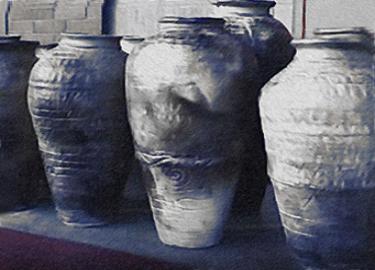
                        The pottery commission of 2006 was based on          
                         some existing pots that had the qualities the             
                         designers were looking for.  The challenge was        
                         that the pots needed to be over twice the size           
                         Lawrence had been most comfortable with.              
                         They needed to be 20 to 24 inches in height to
fit into an alcove, or "niche" in 104 rooms of a hotel in South
Carolina.   With some thought and several trials he realized these
pots couldn't be created in his most usual way which was
wheel-throwing.  He was comfortable enough, however with
handbuilding techniques.  After consultations with the client he
decided that "coiling", though slower than wheel-throwing, was
going to maintain the aesthetic sense of the kind of pottery he
truly admired- natural, accidental and intimate.
One of the more unusual treatments in this commission is the
application of beeswax as a finish. Lawrence had used it on the pots that
originally caught the attention of the clients, with the idea that it would
enhance the smoked patterns and seal the pores of the low-fired clay.
The wax can be buffed and polished to a soft lustre.  The primary source
of this idea is his exploration of "encaustic" originally applied to rigid
panels, with deep pools of multicolored layers of wax. In contemporary
usage, beeswax can be brushed on paper over paint imparting a
translucent filtering effect.  In the case of application to pottery, it can
mimic the effect of the unctuous, soft and thickly flowing black raku
glazes.  The clients of the commission liked the effect enough to retain
some pots for their personal collections.
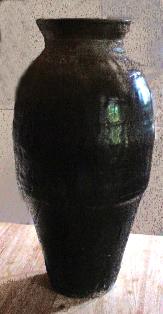
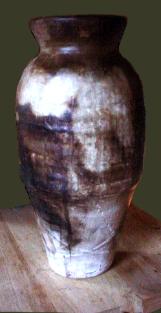
The patterns, called "cloud shadow" are
applied by placing the bisque-fired pots in
a metal receptacle with combustible
materials.  The slowly burning
wood-chips, leaves, Cypress mulch and
Rosemary branches (Lawrence cultivates
hedges of Rosemary around his house)
impart accidental patterns like clouds.  
They constantly shift and redistribute
themselves, rather like clouds.  The
interesting challenge is to discover and
promote what is pleasing, perhaps fitting
the form the most.
Interested in buying Lawrence's pottery?  Check
back regularly and this site will always have
several pots for sale through Paypal.  Lawrence
stopped producing pottery on a regular basis in
1982, but there are some from our collection
and possibly more to come as interest dictates.
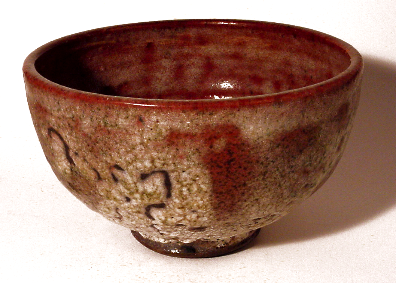
ashglaze teabowl     circa.1985
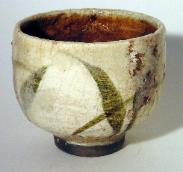
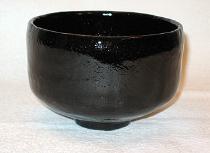
Raku teabowl          circa 1976
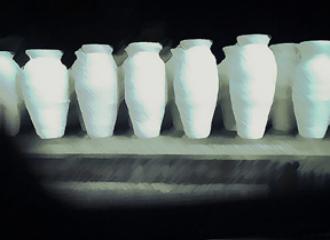
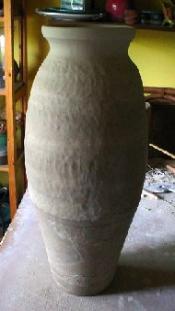
"greenware" showing fingermarks