Part One: The apparatus behind a traditional craft
I have developed and adapted the apparatus I use to make silk strings over many years. Some of its parts are ordinary components; others are tools I made to solve particular problems. Together, they form a reliable system shaped by experience, experiment, and the practical demands of the craft.
This first installment introduces the equipment. The story of how I use it—and why I have arranged it as I have—will follow.
Silk strings are not simply a material wound into a finished form. Their result depends on the maker’s understanding of how these parts cooperate. This short illustrated preview introduces some of that equipment. It is a sample section for discussion, not yet a complete technical instruction: the captions will identify what the photographs show while leaving room for precise explanations of sequence and function later. My plan is to create a small book to share my experience and techniques, and this is a start.
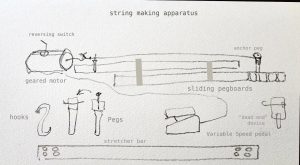
This is the basic setup I’ve used for 20 years
The working apparatus
Some tools I made for myself:
Hooks
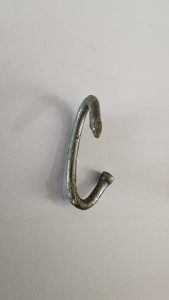
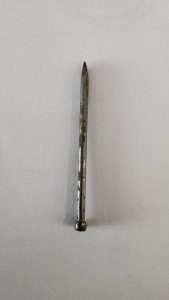
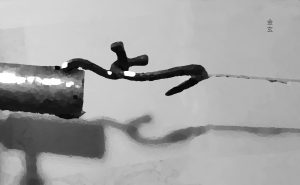
Hooks made from finishing nail
“Anchor” Pegs
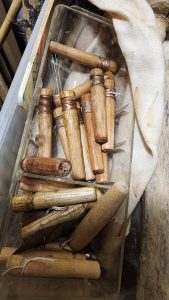
The peg arrangement is part of a practical working system built around the maker’s bench. The pegs are handmade and adapt to different uses.
These pegs are wrapped on the end so a straight nail can be inserted to anchor a string. The wrapping protects the end of the wooden peg from splitting under pressure.
This is a basic “tuning peg” that can be used to add tension to a string while drying, based on pegs I’ve made for musical instruments.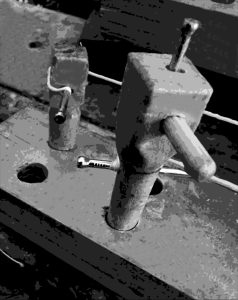
“Tuning” Pegs
The nail can be removed from the top with the string attached, and inserted into the side of the peg. For big strings, I have added a wood dowel for more leverage.
I use reversible motors to spin the strings.
Some silk filature is spun sunwise, while others are the opposite. It makes a difference when many filaments are gathered for a specific gauge, and spun together. When plying a string, the direction of the plies must be reversed.
There is a variable speed pedal.
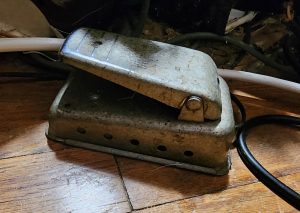
variable speed pedal
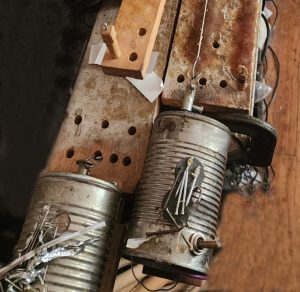
Geared Motors
The speed pedal is a variable resistor. It is a reliable way to vary the 12 Volt DC voltage to speed up and slow down the spinning while it leaves my hands free.
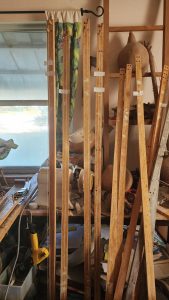
Stretcher bars with strings
My space is relatively limited, so I store my strings as they age, vertically. This also makes it simple to return them to my work bench as needed. You may see I mark the strings with basic notes on small attached papers about the gauge, and for whom it was made.
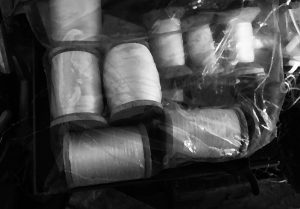
Spools of Silk Filature
These are the basic tools and some hints about my method. The book I create will go into much more detail about my “dance with silk” and how the strings are made suitable for musical instruments.
Let me know if this subject interests you in a comment.


