Wet Paint Class

I dreamt I was in school. It was just to pass the time, an evening watercolor class, but it was really packed with students. The instructor carried a very important air, but suggested we all try to paint something of a grassy landscape, just to get started, and it was meant as just a simple exercise. I found myself in a kind of search for materials around the room, while everyone seemed to going full-tilt with whatever they could lay their hands on, leaving me with nothing at hand for myself to use.

I made furtive attempts to collect just SOMETHING to paint on, and with, while I watched some people going crazy with huge highway-sign sized monstrosities and bejeweled backdrops. A lot of it seemed really great, and I was excited for moments, just to find no one was really looking at what they had, but so very confident what they were doing was really great.

I went from room to room and then out into the street to scare up paint and paper of ANY SIZE or color, just so I could get started. I had seen so many great ideas working out in the other’s paint, only to see them lose it again because they didn’t know when to stop with what there was. I tried to catch the ear of the instructor, who wasn’t listening, but he chatted on, also with no one else listening. I said to no one, “It’s really so much about just stopping at the right moment. But then so many times it’s too soon or too late, isn’t it?” But then all the ears seemed deaf and self-satisfied in mutual congratulations.

After an odyssey of attempts to extract some materials through my scavenger hunt, and many near finds and slip-ups, in desperation I returned to find the whole lot of them had folded up and abandoned all their work, now dripping color all over the floor. So I took up some of those abandoned materials, folded some paper and made a little painted yellow hat and inscribed it with a few wet umber strokes.

Along came a very fashionable lady, who declared she LOVED it and wanted to show it to some of her other folks. I couldn’t quite make out what I’d written in block letters, but I think I wrote, “This HAT is NOT for general USE.” Or maybe I just wrote “NOT A HAT.” It just seemed a good idea, right?

image

Any way, I felt the sense of helpless desperation leave me, just the way all the paint in the abandoned art was flowing across the floor, (and the little hat on the way out the door!) while I picked up the paint again, off the floor with a good brush and some nice clean paper.

Posted in Art | Leave a comment

Etsy listing available in my shop

Check out this item in my Etsy shop https://www.etsy.com/listing/246227315/taoist-water-talisman-disc-in-felt

image

Water Talisman in sleeve

Posted in Art | Leave a comment

Tea Dream

I had a dream, too. I had just come into a harvest of tea leaves. I decided that I needed to toast them before a carefully prepared fire. When it was done, it was WONDERFUL. At least to me. A huge harvest of beautiful, rich tea.

image

Roasting tea leaves, traditional

So I shared a cup with someone regarded as an expert, whom I really trusted. He quietly told me it was not as good as I thought it was. He said I shouldn’t try to do things I wasn’t trained to do. That only people brought up in a Tea family should do such things. He just said “It is impossible, you fool only yourself.”

When I recalled this dream later, I laughed out loud. I had just seen this person inhale my cup of tea with deep, secret satisfaction.

image

Raku Chawan

Posted in Art | Leave a comment

Real Silk Strings for Guqin now available in US

image

I have been making Real Silk strings for Lyre and Guitar for several years. My very favorite instrument, however, has been Guqin, one of the oldest known stringed instruments. The requirements for Guqin strings are much more exacting than any other instrument, too. They are commonly stroked and pressed against the surface to produce a sliding tone, so they must be very smooth and exceptionally hard.

With the experience and feedback from satisfied users of my Lyre and Guitar strings, I have developed strings of length and smoothness that are now on a par with strings made before the Cultural Revolution in China. The Cultural Revolution nearly caused the extinction of this wonderful old instrument. The craft of making Silk Strings was, for a time, lost and Nylon was used instead. Now there are possibly 3 Silk string makers including myself in the world.

I like to de-emphasize the elitist trend that seemed to make it appear necessary for the Chinese Cultural police to force the Literati tradition underground. An unfortunate effect of exclusivity is that it often manages to isolate Taoist practices from the common population. I personally consider it a misreading of the Tao Te Ching to raise the Cultural standing of gifted individuals to such a level that persons in support roles are undervalued. The Old Man (Lao Tzu) never denigrated the average person. To the contrary, he recognized frequently in attributed quotations that it is indeed the day-to-day activity of steady labor that raises a culture to sustainability.

Silk has been preferred for centuries in heirloom or reproduction instruments, especially appropriate in Asian and Tribal music for which loudness isn’t the important thing, but rather, rich harmonics.

I have been making Silk Strings for several years, and have perfected my way of working with silk, based on Japanese and Chinese methods. As far as I know, I am the only one that makes silk strings that are available for purchase outside those countries.  Instrument makers and ethnic musical instrument enthusiasts have expressed a strong interest in my work with silk.

Standard Guqin Strings

In order to make it easier to choose a size I am posting the string sizes separately. Keep in mind, too, that I can create custom diameters specifically for your instrument.

My process owes a debt of gratitude to the notes of Alexander Raykov, who pioneered many methods that I have distilled to what I believe to be the best blend of what I have learned. After spinning the plies to the correct twist I harden them with a special vegetable based glue, I then treat the string with a proprietary resin formula that is unique to my work.

My resin formula is a combination of beeswax, shellac, Copal, and other plant-based poly-resins. These are all-natural and renewable materials that I have used in different combinations for many years.

Why Silk Strings?

Real Silk strings are kinder to your fingertips, and are easier to press against a fretboard.

Real Silk strings are unusually resilient and do provide richer reverberations; a crisp pluck and harmonically rich finish.

Real Silk will give your vintage or traditional instrument a whole new voice of distinction and complexity.

New Real Silk strings do require several days of tension and frequent re-tuning at first.
After 3 or 4 days the strings will stabilize and hold tuning better than gut strings, either real or simulated.

You should bring up the tension of any new strings slowly over several hours with sensitivity to whether it is within  an approximate 1/3 of their breaking point –(a point at which the string begins to sound more like a metal string!) Yes, if you tighten a string beyond a certain point it will break. Use discretion.

Strings will slacken over several days and stabilize to your local humidity. I like to keep a hygrometer close to my instrument to observe objectively the changes over time.
Each string comes over 92″ long; this is enough to re-tie the string as the first 6 to 8″ wear.
The average lifespan of a good silk string can be 7 to 10 years if properly maintained. A stable environment for your instrument will be stable for the strings.

Order a Custom Gauge and length for your particular needs. This may take up to two weeks to produce.

https://www.etsy.com/listing/231573417/silk-strings-for-guqin-order-separately

Posted in Art | Leave a comment

Netflix uses Texas Yarrow in Marco Polo Movie

https://www.dropbox.com/s/0j1xj16je7dpxm5/2014-12-16%2021.24.06.jpg?dl=0

Posted in Spiritual Dimension | Leave a comment

Raku Music

People ask me if I am ever bored when I do things they find tedious. I would suggest to someone like Oscar Levant that they REALLY pay attention and their boredom would be dispelled.
“I never go to concerts anymore. If the artist is good, I’m jealous. If he isn’t, I’m bored.??? -Oscar Levant

The Japanese character “Raku” is a beating drum, and suggests the idea of rhythm, happiness and pleasure.  So Raku Loop for  Theremin wouldn’t be a bad idea but I doubt that it would catch on.
For my silk strings, I will need to provide a “filler” to make them smooth, and be sure my adhesive stays intact, yet flexible.  I am looking at a montmorillonite clay. An idea offered about “Moonstone” (or feldspar!) would not seem far off, except for its thixotropic properties. A much finer microcrystalline clay should be better for this purpose. Montmorillonite clays have almost organic properties and can form polymers. I am looking at Grolleg clay, that I am very familiar with as a porcelain clay, for my strings. It will provide a smooth, flexible surface. The natural PVA compound that I have been exploring is the perfect adhesive, I believe.
Posted in Art | Leave a comment

How to Use the Yao Staves

I thought for quite a long time exactly what to call these things, that could perhaps more appropriately could be referred to as “dice” but I didn’t want to emphasize their possible use a divination device in themselves, but rather as a tool to replace the practice of stopping to pick up a pen or pencil to write down each line. From my first experience with the Oracle I felt a disconnect with the flow of the Stalks -or even coins, for that matter if I have to pick up a pencil and draw a line.

Staves (end view)

The first time I saw such a set of “staves” used, it was a lightbulb bursting into illumination for me. Yes, you can toss the staves and create a hexagram, just like six dice, but the purpose I envisioned then was to create a smoother way of working with Yarrow stalks!

image

Since I began working with the I Ching as a primary source of wisdom, I quickly found a set of stalks to use. My first 50 sticks were actually the long Cattail stems I collected from the side of a pond in Irving, Texas. It took me years to encounter Yarrow growing in the Rocky Mountains and, perhaps surprisingly, the time I spent there only afforded me the opportunity to collect the ferny leaves and appreciate the healthy scent of this lovely plant.
image

It was not until that late time of year in Austin that I found the plants growing long stalks and white flowers on them. Even then, I did not find enough good material for more than a single set for my own use. I did not feel justified to mow down an entire field of these “weeds” for more than my immediate needs! I felt a strong connection to the nature of this plant was needed for me to offer them to others, and it took several years to establish my own plants, of course.

So with that in mind as a basis for connection with the I Ching oracle, it seems to me the Staves need to be similarly consecrated as divinatory tools if they are to function well together with the Yarrow. Their function is to act as a memory device, and for me as a record-keeper to translate the connected movements.

Staves ib Box

Set of Staves in Special Box

I personally like to keep a set of staves nearby as a kind of reference for any number of other purposes, including use as a musical mnomic. How does this work?

If you become familiar enough with the solid and moving lines, the Yin and the Yang of things and events, there is a kind of language there you can use. The Trigrams:

1. of Heaven, Sky or Air, then
2. Wind, then
3. Thunder, then
4. Water, then
5. Mountain, then
6. Earth, then
7. Fire, then
8. Lake or Valley…

…each have a universal meaning that can be used to express something, and coupled with another trigram, will have a special meaning together in the cycle of growth and decay expressed in the I Ching. The relationship of a pair of trigrams is a microcosm that relates a specific meaning you can carry with you as a means of expression.

Since these trigrams create a set of relationships it is natural to apply the meanings to an abundance of processes just as the Old Ones did in Asia for many centuries. I am working on s kind of musical tablature for Guqin at present, and expect this may take some time, but it is only one of many applications I can think of besides the Oracular use. Your own imagination can be similarly stimulated, and your connection to the trigrams more enriched by the use of the “Staves”

Posted in Art | Leave a comment

A New Aid for I Ching Consultations

I have seen offered for sale a set of wooden staves marked with the 4 types of lines generated with either coins or Yarrow stalks. But the price was rather high, and with an attempt to actually purchase them, found that they are not actually available not anywhere, after all.

With some deliberation I set out to find a way to produce them, in quantity and for a good price. Not as simple as it might appear! Yes, one way would to track down a manufacturer of small plastic toys, but I’ve witnessed the results of this approach. There is a long setup to a less than satisfactory result, a committee of bad decisions and someone to purloin the entire idea so wonderfully simple that only some thousands in the entire world would appreciate. For me, that may be enough.

So my approach is different. As an Artist, I am familiar with the “long shot” of first to have an idea, then to produce it, entirely my own way. Limited production of something that appeals to a limited audience, is either a nightmare or a brilliance that depends on your patience, I think.

So I sat down at my PC and proceeded to create a print of the series of lines spaced exactly to fit around the circumference of the material I found available from a supplier of wood products to model makers. The poplar wood I found is mostly very consistent and light in tone, and the exacting needs of professional model builders. There are people who create either architectual displays, or model airplane enthusiasts who need straight and true, inexpensive material they can count on. It is to this source I also went in my search for the best material for my idea.

Set of Staves, White Lines on Black

After several attempts, I seemed to have the size and spacing exactly right, and proceeded to make my first run of several dozen. Yet by the end, I began to find several instances of lines too off-center by the time I finished wrapping, and rejected them with dismay. It was not until after several tries I came to realize the exactitude of my wood material was not of the same order as my prints!  What I learned to do was to carefully start out with my placement and retry for fit as I progressed. I did not count on the accuracy of the material, but compensate from the start for the irregularities of the poplar. All this by way I mention is to illustrate again the difference of approach from a manufacturer`s way, to the way of craftsmanship. This difference I have observed in my life as an employee of others, of those who have little respect for materials and often try to force an abstract concept to appear in a living material. Today, I am once again celebrating that I work alone so there is no blame, but a constant interaction between an idea and the even better results of bowing to the needs of the materials.

Posted in Art | Leave a comment

Observations Concerning Articles for Divination Purposes

Green Yarrow stalks with French Polish

One of the reasons we typically consult an objective source for our practices of divination is the ease with which our personal ego can often enter into our interpretation.
We use a specific discipline and set of tools to avoid the kind of confusion that results from purely subjective readings. This way we get ourselves, as oracular agents, right out of the picture so that the accuracy of the message will be more apparent to the inquirer.

https://www.etsy.com/listing/213384672/yarrow-stalks-50-with-french-polish

To this purpose it is a matter of making a ‘good show of it’ thatwe have the best, evocative tools at our disposal.  I provide Yarrow stalks and ‘staves’ (or reference dice):

Wood Staves imprinted with Yin, Yang, Old Yin, Old Yang Lines

to make the process of consultation flow, to maintain a meditative atmosphere that is the preferred process of counting the stalks to determine the lines- Yin, Yang, Old Yin and Old Yang.

Years ago I was learning the many faces of the I Ching, and in the appendices the description of the Yarrow Stalk oracle caught my imagination. I later found them growing in a vacamt lot in Austin, and I thought it would be wonderful to cultivate and offer the stalks to others. It was many years before this was possible, but the widespread use of the Internet for commerce finally came about, and so the time had come.Years ago I was learning the many faces of the I Ching, and in the appendices the description of the Yarrow Stalk oracle caught my imagination. I later found Yarrow growing in a vacant lot in Austin, and I thought it would be wonderful to cultivate and offer the stalks to others. It was many years before this was possible, but the widespread use of the Internet for commerce finally came about, and so the time had come. I planted a substantial bed by our house behind some Rock Rose, so the weedy appearance wouldn’t attract the ire of the neighborhood, but if I had my way I’d replace the whole lawn with Yarrow!

Posted in Art | Leave a comment

Torn Bookpage Collage

Used bookstores are the kind of place that I like to get lost in. Martha and I enjoy different kinds of books, so we inevitably split up and meet again for coffee at an appointed time. ?She complains lightly that she often finds me in the same spot that she left me, still reading the same book! ?But this is not really true at all.

Half Price Books, Dallas

Half-Price Books on NW Hwy, Dallas

Sometimes I wander around with a vaguely disinterested stare until something catches my eye, and then I settle in to investigate. My theory is holographic. If I pick up the thread in one place it will inevitably lead me back to where I need to be, and the journey is my entertainment. I subscribe to The Perennial Philosophy…. in which each thread is always leading back to the essential nature of a thing.

My Pit-fired pot c.1975 with stencil

(see: Aldous Huxley _The Perennial Philosophy_
“If one is not oneself a sage or saint, the best thing one can do, in the field of metaphysics, is to study the works of those who were, and who, because they had modified their merely human mode of being, were capable of a more than merely human kind and amount of knowledge.”)

That is not to say that I subscribe to the romantic sense that someone becomes more than human by some means. Rather, I would take the opposite notion- that human is pretty darn good enough. ?But to realize the full potential of what a human can be, no one approach is better than another, but must be fully engaged in order to benefit from it. There is some meandering thread that brings one back to who or what we already are, but now, from another perspective we might realize what it is to be fully human having made the journey.


Bowl c. 1987

We inevitably have more books than we need and so once again we go back to the used bookstore to trade in our books. On a recent trip I had a box of books that contained some unusual books and some better collectible hardcover editions that I was pretty certain would be worth a few dollars, but instead when we returned to the desk for our “offer” I was shocked at how little they were worth. “The paper alone,” I thought, “must be worth more than that!” So when we passed a bin in front of the store that said “free books” I noticed a set of Robert Louis Stevenson’s Literary Works and picked them out. The paper was slightly discolored at the edges, but it was a rag paper of good quality.

Torn bookpage: from _The Golden Scorpion_  -Sax Rohmer

page from: Sax Rohmer’s _The Golden Scorpion_

Musing on the changing nature of books in a contemporary context, I began to have some idea as to how I felt about the paper and its texture, translucency, the touch of a page between fingers. The paper was slightly brittle and I began to tear it. I have cut stencils for many years, going back to my schooldays making snowflakes. In this case, the edges I created were somewhat soft and meandering and I suddenly thought of my paper applique’ on pottery. ?The most successful of these were a matter of removing the paper cutouts after the clay was a little dry and brittle, the edges tearing through the slip with a meandering effect.

Now the torn paper edge had that informal sense I was missing when I used blades to cut the paper stencils, and I could wander to some extent in an unconscious sense of what was pulling me over the printed words. Now, as the openings are defined as the primary shapes to be removed, it leaves the imprint of their absence.

‘Strut’ Torn Bookpage Collage

This is another kind of thread, and the connections between the thoughts expressed by the printed page are not so obvious. If one follows the thread it may appear that no passage has occurred, that the lateral direction of separations of letters are not in fact movement at all. Is it simply a destruction of property. Does it in any sense diminish the words? Since I can with little difficulty bring up the entire collection of Robert Louis Stevenson’s printed works electronically, there may be no need of an actual book printed on an actual page. The words begin to spill out into cyberspace, reflected in the layering of more words floating above the stencils as seen in “Strut” (above)

So the act and the result of tearing a page into complex designs is a kind of renewal of value to the touch and texture of a bookpage. ?The words are now a secondary kind of texture that create a kind perspective, floating above.

Now, as I skim through the shelves of books in a bookstore, I am looking at the paper, at the quality of the print on the page. ?Some books fascinate with the variety of typeface and placement of illustrations and chapter headings. The paper, “hmmmm,” I think. Will this tear nicely? What kind of edge will be revealed? It is only secondary that the story can be read directly from the page. Let’s start a new one.

(I can’t convince my own children to take the time to read them either way. Maybe _Treasure Island_ will one day intrigue my grandchildren, but probably they will read or listen to it electronically.)

Posted in Art | Tagged , , , | Leave a comment

Torn Bookpage Collage II

I created a page on my website where the results of my bookpaper stencils can be seen, but I thought I would go into my process of creating finished work in this series. ?My previous work with graphite and grease pencil has already been covered in the
previous post.

‘Strut’ Torn Bookpage Collage

While I relax in the evening, I will have several pages pulled from books ready to work on.
I’ll sit and explore some folds and basically create simple origami rectangles and triangles and pile them up.

Then I take each one up, and as I examine the directions of the folds with a very open sense of what the possibilities are, I’ll begin tearing lines, changing directions, follow an internal labyrinth. ?The idea, I suppose, is to never go directly to a destination, but to shift position; turn just before I think of turning, or slightly after. ?The paper also has a way of telling my fingers what to do. The layers of paper shift a little, slide out of place enough so that I need to flatten the folds again and begin from there. ?I don’t throw away the pieces I remove, and have lately been reserving them to be put back, leaving the little torn journey to delineate the composition.

When I feel like I’ve reached the end of the inherent possibilites, I’ll slowly open the page to see what new shapes appear. I flatten them with an iron, but as everything you do to a piece of paper is recorded on it, the folds themselves become a part of the overall composition.

Lately, I have been ironing beeswax into the flattened stencils, and that creates a transparency that I very much like. The printed page shows both sides now, and the interplay of the typeface is significant, becomes more of a texture than of a narrative.

The next stage is often to scan the stencils before I mount them for presentation, as the digital version can be further manipulated in so many ways. When combined with my graphite drawings, the choices are increased dramatically, as they can be enlarged or made smaller, or transparent- I can cut out the textured print and expand it beyond the boundaries of the page.

Torn bookpage: from _The Golden Scorpion_ -Sax Rohmer

I use an archival spray adhesive lightly on one side of the stencil and place it on a printed background. The background can have a printed color or texture.

To complete a given piece, my mixture of copal, damar and beeswax is brushed lightly over the whole, and heat is applied until the paper takes up the medium and becomes wonderfully translucent, the printed inks appear in subtle relief. For presentation, the print is then mounted to a larger sheet of rag paper so that it has a large enough margin to be handled until framed.

Posted in Art | Leave a comment

Driftpod, Found Wood sculpture

LOGON: I am excited by this construction, have just added the detail connection between the parts.  For months I just looked at it on a shelf, deciding the exact placement, adding the burnt collar and spot and just leaving it alone.  Then the little wood circle with just that one tiny hole.  It’s all held together with 1/8″ square metal hand forged nails that I worked on my little anvil with a torch.  The wood is so beautiful, it has no need of a finish or other treatment.

Logon

Logon, spalted wood construction

It is now available on Etsy, along with several other new projects.

Posted in Art | Leave a comment

Graphite, Grease Pencil, Collage

In August my drawings on graphite began to pile up. I began to scan and play them against each other with transparency and color.

Zebra Lines; where they begin and end is another line

To begin with, the lines were just about extent and depth.  Between the beginnings and ends there is a gap that describes another line.

On each page there is a space defined and shaped by each of the lines reflected in the next.

'Range' -a small work on paper using grease pencil.

At the  same time, I was working with the torn paper collages, so I began to draw my lines to reflect the meander and separation of torn paper, but in only two dimensions instead of the three that tearing paper  creates.

Meander

Again, essentially the lines look straight, but from an imagined perspective they would change directions but you can’t see that in two dimensions.

It appears far-fetched! But i also found it interesting that between the change of direction on each side it was unclear that they were not separate lines, but one continuous one.

'Then' digital collage

So to continue, by overlaying these elements with reverse and transparency I create a deeper sense of space, and perhaps a little mystery.  The colors are what appeal to me at the time I am making these.  There is the inevitable decision as to how best work one thing against another.  I think that’s what keeps me going, always the open question, “What happens if I do this…?”

'Irinia'

In so many ways the lines I was drawing then were a reflection of the kind of torn edge, but the torn edges seemed to become a little richer for the time spend rubbing grease and graphite into paper.

Posted in Art | Leave a comment

Two new reconstructed photos: PELICAN, CPCP

I was walking again by White Rock Lake in Dallas, always with an eye for a particularly interesting wave-formed piece of wood, always looking for a length of bamboo. I look out on the lake, and notice the sudden appearance of pelicans, drifting by at a steady pace. I also spy an interesting arrangement between cormorants and pelicans. What’s going on in my mind during my walk? Hardly anything at all. I am aware of my surroundings in a heightened sense- I hear and see all the life around me, and the occasional bicyclist or runner.

Wabi landscape

I feel the wind and watch how the surface of the lake reflects the sky in response to the movement. I watch the clouds form and disperse or meet up and cross over. I shoot a large number of files and hope I find something good tomorrow, while I pick up a couple of interesting chunks of wood, often right out of the water. I find some lengths of bamboo tossed and sculpted by the wave action and often the teeth of small animals. What do I keep and what do I leave behind? As soon as I could list a set of requirements I would cross out half and come up with some more. But in general, they have what I consider “wabi.” That’s another unquantified trait. It’s not my word. It’s not even a word used in my own native culture, but it is a word like ‘prajna’ -a word to describe something my native culture is just becoming old enough to acknowledge. And it’s the search for this Wabi nature that is becoming the definition itself. There is no one particular thing that determines it.

Spalted wood with mysterious inscription

The next day early in the morning I think “Oh, there’s nothing.” I slide the SD card into the reader and look at the files again. Then I calm down a bit and just stare. Soon I begin to be aware that some of them have a somewhat interesting texture. Or some interesting contrasts. I find the waves have useful texture, and one of the pelicans gliding by has left a dark wake and the lake is quiet enough for a slight reflection. These elements, taken one at a time wouldn’t suggest anything. But slowly together I begin to develop a sense of something I missed.

Pelican on White Rock Lake 03-10-12

So I load the most promising file into Adobe and begin to pare away all the extra bits and then develop the wave textures. Eventually I have something like polished, igneous, frothy stone with an aquatint pelican swimming through.

Lately, I have been including some printed copy in a rectangular block. I think it starts as a title, but sometimes the letters are ambiguous; another kind of expression. Something about the monochromatic quality of the finished piece begs for a touch of color, so I have been adding some vermillion stamps lately.

Cormorants and Pelicans

Cormorant, Pelican, Cormorant, Pelican.

I won’t go through all the details of my Photoshop process, because it is very complex, and I never do quite the same thing twice anyway. I’ve been working with the filters in Photoshop so long (over 10 years) in so many combinations I don’t remember any particular combination or settings that will give an exact result. It all depends on what I have to start with, and that’s a huge variable, anyway.

For the CPCP photo, I knew right away that dark stain on the pillar of the bridge was a focal point I wanted to work with. With just the right space between them, with the patient wait for fish to swim by, the thing that got my attention was the alternation of cormorant and pelican. The black and white of it and the balance of small black figures against large white ones had instant appeal for me.

Posted in Art, Spiritual Dimension | Leave a comment

Spalted Wood Sculptures: PENTE

Pente

Pente

It’s not easy to describe how many decisions have to be made before I feel like I’ve done anything good with the beautiful wood I find.  The wave action on the surface and the total transformation of the structure of the wood itself through bacterial action makes it almost an intrusion into the natural process.  My minimal drawing style with a torch or hot metal does, I feel, complete a process that started many years ago when the tree dropped a limb that wound up in water, floated across the lake and then came to rest at the shore before my feet.  I eagerly search the shore as I walk along, but it is only when I stop for a very long time -and wait-  that I actually see anything.

New sculpture in progress

Sawed oak knee with recently found branch

My current form of personal meditation is aided by the sound and sight of waves.  They are never the same.  The sound is a kind of music, but not composed music.  It is wild music; untrained music.  The solidity of this music is trapped in the wood, and when I draw on it the musical score that is in my head, I feel like I’ve at last expressed something that can’t be put into words.

Cattail Reeds

Floods at Imbolc

Posted in Art | Leave a comment

EGRET: spalted wood sculpture

Ancient Taichi Carving

My approach to sculpture is inevitably connected to my pottery and claywork of the 70’s.  What I always admire in clay is the close relationship between the local terrain (under the ground is always some kind of clay) and the forests above -wood turning to ash transforms the clay into glass.  Ash, then, can become a kind of glaze, and part of the clay.  It’s a cycle that begins with water, of course.  That’s why wood, for me, is closely related to clay.  It’s also why gazing at moving water is related to wood.

It is the Chinese five-element system that I realized one day while sitting out on the site of a brush fire.  The local clay had turned an orangey-red around the edges of the burn, but at the center, where the carbon collected, there were dark bluish bands, and then nearly black.  The black is simply the presence of ink-like carbon, but the blues are the unmistakable alchemical properties of iron.   Iron is the secret ingredient of most pottery glazes, including the beautiful celadons of infinite variety, and the many kinds of of iron glazes that range from rich blue-blacks to warmer reddish blacks to a persimmon color.  As important as color, the textures of iron glazes is a result of the stages of melting silica into glass while the iron itself is transformed by the atmosphere of the fire.  Unless the materials have already been melted into glass, then pulverized and reduced to powder already, the chemical interactions create many stages of bubbles and flow. The exquisite textures of many traditional glazes are the result of the interaction of the elements of glass; silica, alumina and flux.

Five Elements Cycle

When it comes to savoring the qualities of wood, it is as important to be aware of the process of growth and decay.  When wood that was once part of a living tree falls to the ground, a lot of things can happen.  It can be eaten, and slowly disintegrate.  A lot of microscopic activity can transform wood in complex ways.  When a particularly beautiful effect is discovered, it is possible to remove the wood from the original process and work with it.  In this way the process is continued in another direction.

The grain of a piece of wood reveals the process of growth, then to re-present it is a deliberate act of creation.  How much to interfere with something already wonderful is a challenge.  How to present what has been found is an act of revelation.

EGRET: spalted wood sculpture

The best treatment that I have found to interact successfully is to return to fire as a process of transformation.  Pyrography is the deliberate burning of the wood in certain ways to create a sense of human interaction in a minimal way.  I like to use several kinds of torches and branding tools to create marks that are not just added to the surface, but combine with the substance intimately.  I like to use beeswax as a finish- it (temporarily!) stops the process of disintegration and often reveals things I see in the wood when it is wet, but as it dries out the surface seems to die, too.  Using such a basic finish seems to bring back that life without covering too much, or just sitting on the surface.  With the judicious application of heat, the wax can melt deep into the pores of the wood and become part of it.

It is similar to the sense of what to me is a good glaze on pottery; it does not sit just on the surface of the clay, but becomes a deep aspect of the clay itself.  When the clay sits slowly transforming in the fire the glaze combines with it and they become one.

Raku Chawan with Lithium Glaze

There is no real difference between clay and glass, except refinement.  Clay is a little more resistant to melting, but my  favorite thing is to break down that difference until there is only enough difference to keep the form of a vessel from collapsing.  In a Japanese Anagama kiln, pottery is fired for several days until the ash collects and melts into the clay; the pot often becomes so soft the shape of the pot itself is transformed. In a similar sense, the difference between picking up a rotting chunk of wood and presenting it as an art object is only a slight difference, one that could also collapse but for certain deliberate factors.

These factors have something to do with the dynamic interplay of conscious transformation of the wood into something nearly something else.  It may be this delicacy of intent or collapse that keeps me occupied with spalted wood.

EGRET: another angle

Back Side

Posted in Art | Leave a comment

Luminarte Gallery Biennale

I was recently invited by Jimmy Manheim to attend the opening of Luminarte Gallery’s latest show “The International Biennale Artist’s Exhibition.” luminarte is a newer member of the galleries to be found just beneath the Trinity River levee. In fact it is on Levee Street, just at the end of Oak Lawn.

The front of the building is an unimposing warehouse, but the interior is a great space to show. The lighting is good, and the interior space is flexible. On one end of the gallery is a raised platform that is perfect for live presentations.

The International Biennale is a large group of diverse artists, so it is hard to decide what the theme should be, other than the sense of diversity and cooperation.  This sense of diversity is refreshing in itself considering the competitive nature of the current art market.

I can’t say any particular member of the group itself stood out.        

What really got my attention was this imposing wall of twigs and ceramic sculpture:

Last Song of Summer by Magi Calhoun

I think it is because I have been thinking about my own work with found wood.
I keep wondering if galleries will be interested in displaying ceramic with wood with a minimum of human interference.  On this wall it works very well.  The ambiguities of sculpted and natural are, to me, quite magical.

by Lee Ables

Visitors at the International Biennale

Visitors at the International Biennale

I thought there was quite a lot of interest in the existing gallery art, as well as the show itself, which is a very good sign.

I thought these paintings by Lee Ables were  interesting.

by Lee Ables

Posted in Art Exhibitions | Leave a comment

Mythologies

LPKaster

I had an interesting conversation with an elderly woman today.  This woman was unhappy and exasperated with her difficult daily conditions.  I tried my best to help her, with her walker,  get through the door and into the office, where she wanted to make a payment.  While we sat together, she complained that she had to travel by bus and transfer twice to get to this office, and that when she got there the charge for making a payment in person was $3.50, in spite of the fact that she had to make the journey to begin with.  I felt like I wanted to help her.

I gently suggested that it was possible now to make her payment electronically, over the phone she was carrying.  She said “No! I don’t trust computers and never will! I refuse to have anything to do with them ’cause they’re dangerous and trying to take over the world,” not realizing she held one in her hand!  The next few minutes I spent with her, she did calm down, finally, and began to smile a little.   Within our discussion of how we both got to where we currently are, she used the parable of lighting a gas stove. She said “If you light a gas stove properly, it will cook your food.”  ”But if you don’t- you’ll get burnt!”  I added, myself, “Indeed, if you don’t handle it correctly, it could blow us both to smithereeens!”  She smiled at this, “I just can’t get caught up with things as they are, and I’m afraid it’s too late. ” I asked her “How old are you?” and discovered she was only a couple of years older than me.

Myth #10: The Golden Age

Parthenon reproduction in Nashville Tennessee

This myth is widespread.  People fall into it as a matter “of course” whenever something of the present situation doesn’t suit them.  It used to be expressed by saying “In the Good Old Days” things were better.  Some time in the distant past things were just better.  If we could only return to the old ways we would be safe and happy, and prosperous.

New myth: We can never go back.  The circumstances that led us to where we are, though often cyclical in nature, are never exactly the same.  The best we can do is observe, predict and prepare for the conditions as they appear based on what we think we know.  If we look to the past we can better understand the conditions we find ourselves in, but we must realize the new factors and do our best to work with them.  On a personal level; complaints are useless.  It changes nothing.

Myth #7: The Great Man (or Woman)
There is someone who has the answer to everything.  If we can find this person, they will show us the way and save us from certain destruction.  This person has the charisma and luck that we all lack, and if we do our best to emulate their activity, we can be more like them and ride their pony. But only to the degree we do exactly the same thing- whatever that is.  In the person of a religious or political leader, they change the course of history.  Some are not even thought to be human, but an alien or divine interloper.  Sometimes through their own personal death or destruction, they keep us from destroying ourselves.  Other people are called a “genius” because their path seems less thorny and their efforts appear light.  If we only had the accident of lucky birth -perhaps a genetic or supernatural gift- we might be that person.  But we don’t.

World Religious Leaders

New myth: No two individuals are alike.  The course of each journey is presented with an entirely different story and set of skills.  The course of time, and similarity of our common natures as a species is repetitive and cyclical. Yet there are also a vast amount of differences, a deep chasm between us. We can  observe each ther at a distance, but never really cross. We can only imagine and hope to recreate some of the most successful parts of a person we admire, but we have to work with what we are given. We, in the end, have to save ourselves and create ourselves, and let others judge the outcome -if they are moved to do so.

I created this file as a reference for those who live by the common mythologies and never realize how much they live by them and never thought to question them.  I invite the gentle reader to examine my new myths and substitute their own.  I am extremely interested: what are these personal myths? What are the widespread cultural myths and how do they go on; unquestioned and unnoticed.  Are they self-evident, or are they the result of indoctrination?  You decide.

My Granddaughter Minnie, and me

When I think of the elderly woman I mentioned earlier,  I am recalled to an agreement I made when I was encouraged by teachers and friends to examine mythologies.  I agreed that the only life worth living is an awakened life, a life of attention and flexibility.  I agreed to move with the current.  We must rise on the tide of change, to greet the future, and make it our own.

Posted in Spiritual Dimension | Leave a comment

Three Artists at Craighead Green

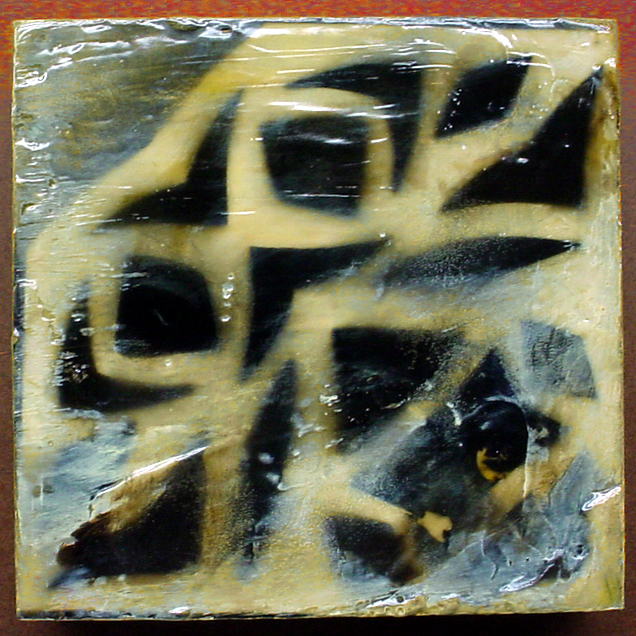
I’ve been working with encaustic for nearly 10 years now, but still getting inspired by the developments of this natural medium. In an era when transparent media poured or sprayed over inkjet prints, the opposite of natural processes, beeswax is suddenly a unique and beautiful thing.

LPKaster Encaustic Panel

LPKaster Encaustic Panel

At the Craighead Greene gallery can be seen some recent work by Winston Lee Mascarebtas, all encaustic with a deep, unctuous encaustic overlay. He uses the ability of wax to alternately hide and then reveal some subtle compositions on a series of small (10″ x 10″) boxes. He didn’t price them too high, and sold about half of them before the evening was out. He manages to build the encaustic very smoothly over stripes or rich, deep color. I was especially intrigued by a cube of 12-14″ covered with a rich yellow. Another intriguing use of the medium is to trap carbon particles within the wax. Mascarenhas also uses Damar varnish as part of the mix, which probably increases transarency as much as it raises the melting point.

encaustic box by Mascarenhas

Mascarenhas Encaustic Panel 10\

When we walked in the door very late in the evening, it was the paintings of Krista Harris that immediately caught our attention. Her colors are stunning! These large canvases are very freely painted, a dialogue of surface and brush that completely renews the belief that there is much more to be done in the Expressionist manner, particularly when the painter believes in the possibilities of hand and brush to express their own relationship with pattern and color, unencumbered by boundaries.

Raymond Sa’a has found some exciting ways with leaf-shapes and line, and the beauty of veiled carbon traces. Martha was especially intrigued by the stitchery that held some of the scales of paper in place. Altogether, the three artists represented very different approaches but together make for an exciting display. Krista’s highly colored brushwork leads into the strong patterns of Raymond’s paper pieces, and then to the Mascarenthas encaustics, an enjoyable journey on a Saturday evening.

At this point, Craighead Greene is quickly becoming one of my favorite galleries, the space is large and leads one quickly through the separate spaces arranged for intimate encounters with the art. Instead of labyrinthine corridors, it is a series of small spaces joined by a major walkway. The lighting is excellent, and the gallery directors are easy to find and talk to.

Posted in Art Exhibitions | Leave a comment

“I Don’t Like Abstract Art???

I’m reminded of some conversations I’ve had with people in the framing industry. The conversation goes “I don’t like abstract art.” says the guy (a sort of carpenter, specializing in art presentation furniture) He is making 200 frames for the art bought by a hotel chain that will be the centerpiece for a room. The room will have a bed, a TV with 57 channels, a lamp and a big window with a thick drapery and one big work of art above the bed for which he built the frames. Maybe a couple of smaller pieces to one side to balance it.. Of course there’s a small bath adjoining the room with another small etching and a mirror.

The picture framer is thinking, perhaps (Emperor’s New Clothes!) But not- because he is unfamiliar with the tale or the possible application of the allegory’s illustratiion of alternate points of view! He never got that lecture, even in a High School class ’cause the teacher was a “Phys Ed” coach who never got it himself.

Now if this guy goes on a trip and needs to settle into a hotel he will probably glance above the bed, and if the art is a landscape he will give it a once-over and think to himself “That’s nice… I like blubonnets.” But he will lie on the bed and stare at the TV for hours, and exclaim aloud “57 channels, and nothing’s on.” The weekly football game is tomorrow, so he thinks. I’m wondering if TV channels will ever need “test patterns” again. I should design those, I think.

home of the brave LP cover

Laurie Anderson- Home of the Brave


The last time this fellow went to an art museum he walked past some of the most groundbreaking examples of 20th century art and went straight for the portrait gallery, then to the gallery of Barbizon School paintings and then to the Turner’s, the Hudson River School and other American Impressionists. Then perhaps a quick scan of French Impressionists nearby, not realizing what a scandal this kind of painting caused, not an inkling of what came next… And this trip to the museum was 10 years ago.

So then when he confides to me, “I don’t like abstract art,” do I dare talk to him about music?

Posted in Art | Leave a comment

Musical Observations

It has been recently observed that there are no completely objective ways to judge the exactitude of art. Much of Science, too, is an art that begins with observation colored by certain personal factors that are not as objective as we are led to believe in school. Charles Darwin began his theories with pure observation, lacking the exact measurement of genes and chromosomes… and even the molecular beginnings of genetic research will fall into the nature of art if you look long and hard enough. Still, (most of us) find his conclusions very conclusive today. Observation is an inexact process and can be wildly different from one position to another, so there will always be a few who trust traditional poetic insight over keen observation (cf. “the Bible”) or read this essay “Art and Artifice”:

Deschanel

Bones

This effect was part of the subject matter of a recent episode of “Bones” (The Doctor in the Photo) and it reminded me of how much our experience is colored by the very ground of our everyday “seat of the self.” The “self” is a composite not only of accumulated knowledge and experience, but of just how we are feeling at the moment. In this case, the main character identifies with the victim of murder that she is certain that the photographs and recordings of the victim are _exactly_ like her. It is only later, when she fully comprehends the events leading to the death, that she realizes there are only coincidental similarities. Her immediate experiences change due to the depth of her new understanding.

There are art experts whose job is to decide whether a work is actually the product of a particular artist. What they rely on is a huge body of referential material that is generally accepted as ‘genuine’ and using their own judgement of the details of these will determine if the work in question is one of a series by the same person. Handwriting analysis, for example, is not a science, but a technique of keen observation and good guesses. Art experts employ the same kind of judgements, but a casual observer or listener- or smeller, in the case of perfume perhaps, will accept a counterfeit because their casual experience is all they need. They call in the experts when the stakes seem higher, but I ask “Isn’t the richness of their experience just as important?” So let’s get serious about this.

Big Koto disc LPKaster Theremin

When it becomes an issue of worth and exchange, the art experts are brought in. Then the casual response goes immediately deeper. Nothing has changed, except the experience. (The casual observer is very gradually seduced into becoming an “art expert.”)

Some might insist that it is all ‘chemical’ in nature and certainly changes in body chemistry can make radical differences in our personal experience. It is also demonstrable that we can change our own chemistry, even using just our own minds. And sometimes the effect can be so slight that we don’t recognise it. We may never know for certain which phenomena leads the way to our somatic reference, the way our bodies affect our minds and ‘tother way round. If we know this to be true, then only time can reveal some certainties we can rely on.

This, and the impressions of a collective, like our families and friends (our own ‘art experts’) make a huge difference in our experiences. And once we are aware of how our response can vary with circumstance it is possible to have a truly aesthetic experience of a drawing, a painting, or of a musical work. It seems to me the personal response to artwork has to be a balance of an immediate impression, yet supported by cultural expectations, our previous experiences. It starts in a particular momentary impression, then stretches to the boundaries of culture.

I simply doubt that objective measurements can be used in art, or in science in any reliable way. I have electronic tuners that work much more slowly and precisely than my hearing, and I trust them more if I want to know what C sounds like. Yet art is all about illusion, isn’t it? By the time I play a note, the reference wanders again.

Posted in Art | Leave a comment

Pyrographic drawing

This is a pyrographic drawing with colored dyes done in the style I have been developing for many years I refer sometimes as “taichi” drawings as the movements of the line are based on my visceral sense of push/pull as in Taichi Pushhands movements.

Pyrographic Drawing

Pyrographic Drawing


The pyrograhic element is the inverse element bounded by the dotted boundary. I discovered years ago how the dotting effect I observed in traditional Australian art will activate a line or a space. I used it to outline some flower images several years ago with great success.
red zinnia

Dotted (scanned) Zinnia


There was at that time a strong interest in images of flowers. Commercial spaces like hotels and hospitals preferred the neutrality of them, I think. The active nature of the pyrographic drawing comes out of the combination of the dotting from these earlier images combined with a drawing style that actually pre-existed these images. I was creating maze-like pencil drawings before the ’80s, even applied them to canvas. But I believe they were too sophisticated for a commercial space.

Posted in Art | Leave a comment

New encaustic drawings

Always intend to show what I am thinking about. This is one of a series that can be seen on my website; http://lpkaster.com/encaustic.html

Brush Circles 3 color 2

Encaustic overlays on drawing


The circles are drawn with a soft graphite over the brushwork, a contrapuntally different way of making marks. The color overlays are meant to be colored beeswax with an impressed woodgrain pattern. Just now they exist as digital concepts, but isn’t that all I can show until someone has a wall to hang them on anyway? The “waves” portion below the primary image are an entirely separate approach, but I think also a kind of underlining feature.

Posted in Art | Leave a comment

Alvar at Galerie Zuger

Galerie Zuger is one of the best showrooms on Dragon Street in Dallas. It has some of the highest walls and has excellent lighting for important exhibitions of first-rate art. I got the chance to hang an exhibition in preparation for the annual “Design on Dragon” last week. Climbing 15 feet up the ladder to set lights was an adventure!

There is so much I need to learn about hanging gallerys. It is really hard work, especially with large and heavy work that needs to be hung quite high. But in the end it looks really wonderful, with the waxed floors gleaming and the dramatic lighting. One of the artists featured is a Spanish artist, Alvar Sunol Munoz-Ramos who is “in the latter part of his career” and very collectible.

Posted in Art Exhibitions | Leave a comment

Show at Dutch Art Gallery: 46 Texas Artists

The Dutch Art Gallery has been nearby our digs for as many years as we have been in this part of town, and I have visited occasionally.  I always felt a sense of comfort and home with the paintings and decor of this gallery.   It’s also next door to the Divine Cafe, a breakfast nook at NW Highway and Ferndale that we have enjoyed for years.   The group of shops ther have undergone a lot of changes, and recently Pam Masser has taken over the gallery since the passing of her husband’s parents. She is a very positive and engaging director of the gallery.   One of the great ideas she is pursuing is group shows.    An organization of 46 Texas Artists “The Daily Painters of Texas” contacted her again this year to do a collaborative show of art whose subjects are mainly Texas scenery and genre paintings.

Meadow of Sunshine   by Kay wyne

Meadow of Sunshine by Kay Wyne

What surprises me, coming from my own background of ‘corporate’ artwork, is the size of most of the best of the show’s paintings.  They are mostly in the 8 x 10 or 9 x 12 range, some even smaller.   But in fact many are great little paintings with lively brushwork that brings one’s attention to the sense of detail.  Many have a freshness of approach that rivals anything on a larger scale.   This, paired with the fact that customers of the gallery have limited wall space in their homes suddenly made a lot of sense to me.

Many of the artists represented called in their friends and family members who were very supportive and interested in the entire display– the differences and similarities of style and subject matter were a significant topic of conversation.  The relationships between the group members and their supporters was evident in ways that I do not remember from my past involvement with art groups.

In the distant past I remember attending art openings and the subjects of discussion were not about art or family, but mostly about awards or financial matters.   That may be one of the reasons I stopped participating in juried exhibitions, though I actually had quite a bit of luck with the awards. What I didn’t miss was keeping track of those 35mm slides and constantly needing to have them commercially printed, and then wagging the work all over town on short schedules, or worse– shipping and returning work safely. When I was doing ceramic work, this was a ridiculous risk and expense, but framed work has its own problems as well. For the last twenty plus years I had the advantage of being included in larger one-way shipments to permanent sites. Oh for the return of that day!

But in the case of the Daily Painters of Texas, they paint so much smaller in general it is an entirely different situation, and the paintings really make a lot of sense on this kind of scale.   It is something of a revelation to me.   I think “Well, small works can actually have big presence!”

I personally enjoyed the opening, as I am working part-time for Pam, and had the pleasant opportunity to serve drinks, switch out some frames and generally be involved as part of the ‘hosting” side of things for a huge change.  It is very heartwarming to have the opportunity to be a part of this local show.   I feel suddenly more a part of this local Lake Highlands community (it is just a good, brisk walk from White Rock Lake) and makes me feel very good about continuing my White Rock Lake series of paintings.

Posted in Art Exhibitions | Leave a comment

Stealing the show

driftwood drawing

Drawing on a nice flat piece of driftwood.

There have been a lot of new developments in my work, which I will deal with gradually. Primarily, I want to welcome the new subscribers, and promise to write more, and pay more attention to this weblog. I am always interested in comments, so please feel free to engage me on whatever subject might come up.

Since the big change in my associations last March, (partly brought on by the existence of this material) I have been working a lot more on my personal work and less on the work of others. Now I am about to stand back a little and find some more common subjects to deal with.

Posted in Art Exhibitions | Leave a comment

White Rock Lake Paintings

In May I started to take photographs of White Rock Lake after a discussion with Martha about how the lake will have a centennial anniversary next year.  I created quite a number of digital images to print out on cards, and started painting large paintings based on my favorite of the digital photographs.  I love the subject, and enjoy painting landscapes.  I try to bring some new kind of reference to each image I create and could likely paint new versions of many images for some time.   One of my favorite views is an overlook of the trees that line Winfrey Point.  Altogether, the most engaging is one that doesn’t actually include the lake itself, but implies it over the edge of the trees.  The dense wildflowers and dried grass of late summer create a series of interlocking patterns. See my page of White Rock Lake images.

Winfrey Pint, White Rock Lake, Dallas

There is also quite a lot of moving footage, one in particular I keep coming back to is a few minutes of a fisherman I found out on a dock one morning at about 5:00 am. What I get excited about is how what seems a most ephemeral and quiet moment can yield a striking image.
Fisherman

This few minutes yielded an interesting banner-like image.  I used it on my homepage after some good responses to my Bandcamp page banner.

Fisherman

Fisherman at White Rock Lake

Posted in Art | Leave a comment

Inheritance

Yesterday my six-year old grandson let himself into my electronic studio, stepped through the door with an air of confidence.  He noted the several PCs humming. One was writing a CD, another processing a Photoshop image, and the third was set up for a keyboard with several Vst instruments installed to filter the sounds I was making. I was playing “Fur Elise??? at a moderate tempo, working out some unusual harmonies.  He looked around and  sort of whistled.  “I just came in to look at your stuff.??? 

I said “Even a cat can look at a king.???  Which is my usual way of saying I don’t mind him watching me too much.

Then he asked matter-of-factly, “Are you going to die pretty soon, daddy????

“I don’t know…??? I tried to keep a straight face, meanwhile “Maybe next week…perhaps Saturday,??? I replied in an off-hand sort of way.

“Well…??? he continued, “When you do… can I have one of your computers????

I laughed.  “Well, by then they will certainly be obsolete. Kind of like me, too.???  No response, no problem with that word ‘obsolete’ but a longer glance around at some of my gear hanging from hooks over the keyboard- piezoelectric pickups and earphones mostly.

 Finally, he asked again, “How many earphones do you have, daddy????  He paused, “I’ll count them!  One, two, three… four… five…??? He concluded.  “You have too many earphones!???


Posted in Scary | Leave a comment

Further reflections about talent

One of the Sales staff is a young woman with some experience singing with a musical group.  I encouraged her to share a CD with me they made several years ago and I found she had an excellent voice.  As I said in my last blog, I always encourage people to sing as they are so moved.  Some people have a natural tendency to silence others who feel like singing, discouraging them on the grounds that they are not “professionals” and that their skills are not up to such a standard.  Nonsense, I say, “A lot of professional singers should stop and listen for awhile.  They might hear something very creative and genuine.”  Discouraging others doesn’t add anything to real creativity.  Encouraging people to express themselves adds more to the general tone of creativity in a culture, not less.

I understand this person went with to a kareoke bar the other night with several of the other sales staff, and they all came in the next day with newfound comraderie, and the young woman I mention was just glowing.  I don’t know if my occasional encouragement might have helped, but I like to think it could.  No one lost, and everyone gained from the experience.

Posted in Spiritual Dimension | Leave a comment

Not For Export

I have been very busy lately with painting commissions and have had only a little time to devote to getting OKAPI launched on CD Baby.  I have received a lot of interest in my paintings of Koi lately.  I have been painting abstractions of Koi swimming in Japanese gardens for over 20 years and sold quite a few to hotels and office buildings for lobby art.  A hotel in Florida actually sent a patron to me for a painting for their home, and we put together something they really like and it is now hanging in their living room.  Several more paintings have been sold and put in place this year and I hope to get some photos of their placement.  I’ll add a page of these photos if they look good.

There is a real demand for video content, moving art for commercial properties.  I am working as I can at improving my editing skills.  I am very comfortable in the Adobe Photoshop environment, and I have Adobe Premiere on one of my PCs.  It is, for me, a long curve to getting familiar enough with the filters and strategies to produce content of real worth.

With this in mind I produced a short film “Not For Export” and put it on a page for sharing with those I think might be interested in how I work with my musical instrumets.

LPKaster "Rings"

"Rings"

I am not ready to stand in front of a camera, but displaying how my hands interact with a keyboard and Theremin I can do.  The musical piece I produced is short and I would probably incorporate it into a larger work if I continued with it, but I think it illustrates how my musical ideas come together.
I posted the page to a mail group called Levnet just to get some reactions.  Funny, when I post a note to this group I get a huge surge in hits to my site, but no complaints about my music!

I read Levnet because it is a wonderful source of information.  The people who post regularly are an excellent source of electronic expertise and will share what they know very willingly.  The professional Theremin players, though strangely conservative in their musical taste, are active listeners.  I feel they are uncomfortable speaking up and hurting my feelings, which they won’t, because I know I am not really trained, as most of them are, as a musician.  I make sound art, which I know is not the same as being a professional musician, but I think my work is at least interesting.  Martha remarked last evening that it was “kind of pretty” but it made her uneasy.  For one thing, she said, it is too complex for her to really listen to.  She is an avid listener to Blues, and Folk music in general and sings, with the passion and beauty of any kind of folk, herself.  I really like people to give voice as they are moved to do so, and always encourage them to continue expressing themselves.  That’s just what I do, too.

Posted in Scary | Leave a comment